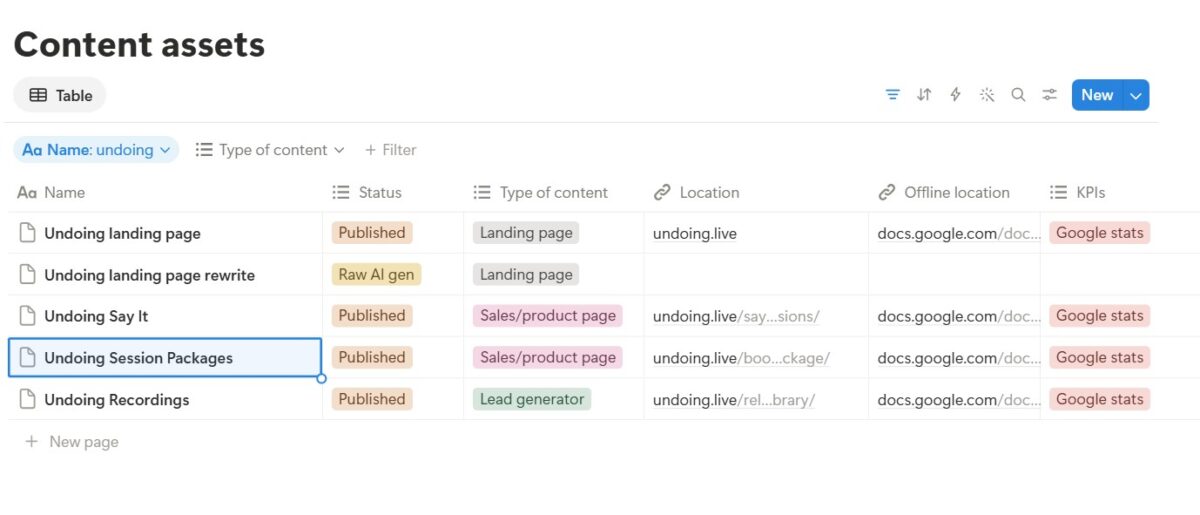
Step 1: Existing Assets
The existing assets catelogued in a Notion database.
Step 2: Identify Key Issues
Problems
- The website doesn’t convert; visitors don’t buy coaching packages or use the lead generator form
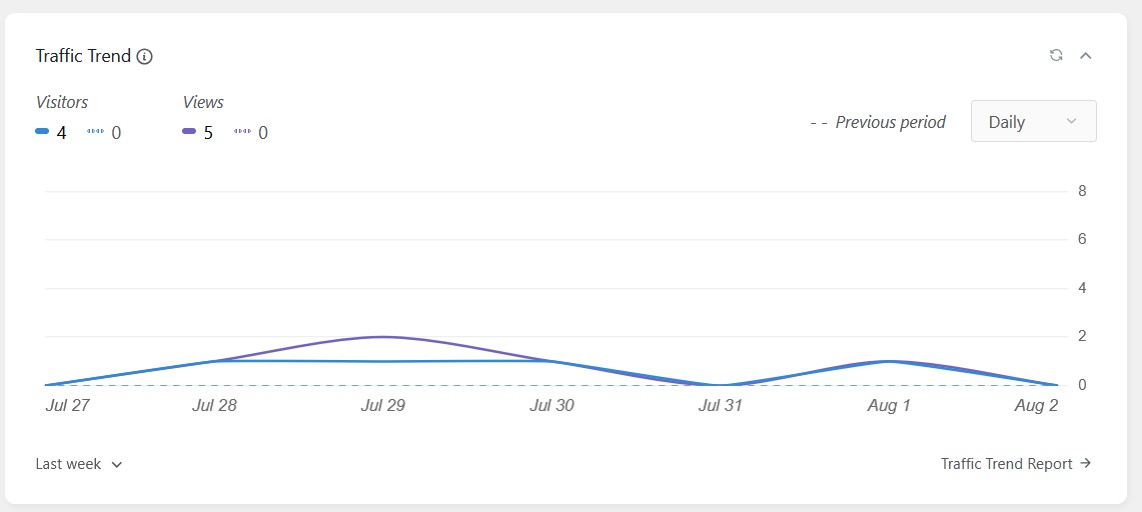
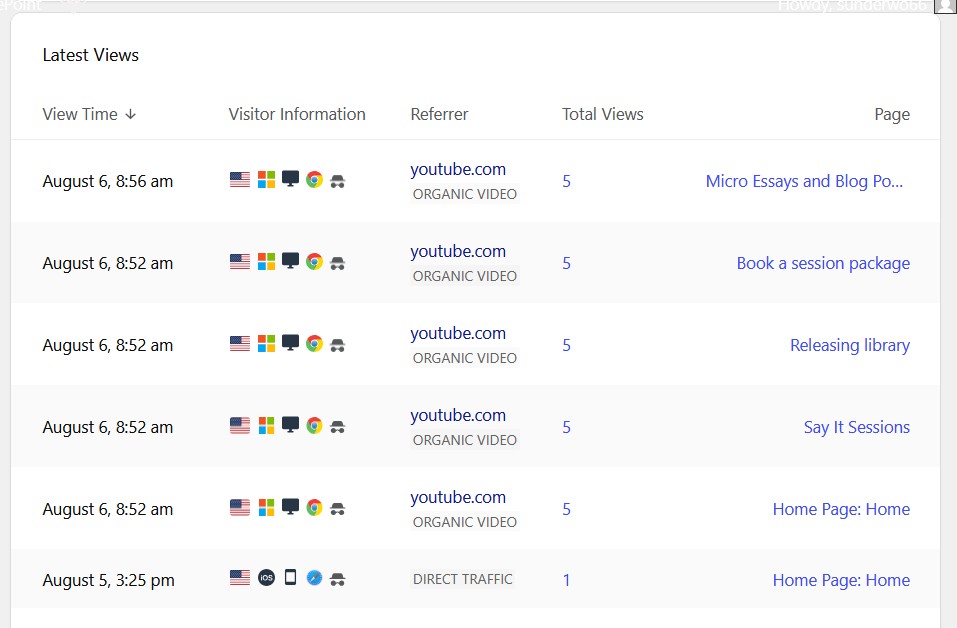
- Site traffic is so low that no meaningful conclusions can be drawn from stats
- The main source of traffic is the YouTube channel
- Calendly subscription has expired so the booking links don’t work
Step 3: Purpose and Direction
Income generation
This offer is a long way from generating a repeated and sustainable revenue (given the reseources necessary to create content for the YouTube channel).
The following actions require minimal resources and represent useful market research:
- A local postcard campaign in Prenzlauer Berg, Berlin (fitting demographic); a draft version of these has already been created Claude Design Postcards
- Utiliize Google Business, given the local demographic
- Post in the Sedona Method group on Facebook; advertisting is not permitted but raising awareness is possible with some well-written posts/comments.
Portfolio Items for Knowledge Management and Content Ops
People enjoy the videos, the feedback is positive so the YouTube and website should remain in place, but instead of attempting to revive this as a standalone business, it makes much more sense to use this a portfolio item for knowledge management, AI applications in marketing and design and content operations.
Step x: Prompt
The Undoing — Landing Page Rewrite & Offer Simplification Prompt
Purpose of this document
Single prompt, run once, producing a client-facing page rewrite (bookings/emails as the goal) while the reasoning trail itself functions as the portfolio demonstration: a prompting and AI-workflow process that stays honest under low-data conditions rather than manufacturing false certainty.
CONTEXT
– Practice: The Undoing — Sedona Method facilitation, undoing.live
– Current offer: [€48 “Say It” single session] + [€280 three-session package]
– Current strapline: “Knowing yourself is one thing. Being unable to stop
looking is another.”
– Positioning: mechanistic, not transformational. No cure, volume can come
down. Self-improvement runs on a redemption-debt structure; intervention
targets the structural mechanism, not motivation or behaviour.
– Current traffic: very low (approx. [X] visitors). Zero bookings/emails at
this volume is not statistically distinguishable from “page works fine,
insufficient traffic to test it.”
– Audience for the output page: prospective clients. Goal: bookings, email
signups. This is not a portfolio-facing document — the portfolio value is
in this process, not in meta-commentary added to the live copy.
EPISTEMIC CONSTRAINT (applies to every step below)
For every claim or recommendation, label it:
[GROUNDED] — derived from the existing page copy, stated positioning, or
voice constraints
[JUDGMENT CALL] — no data available to confirm; state the assumption
explicitly and what would falsify it
Do not present [JUDGMENT CALL] items with the same confidence register as
[GROUNDED] ones. Do not let fluency substitute for evidence.
TASK
Step 1 — Critique the current page (paste in current copy)
Evaluate against:
– Does each section earn its place, or restate something said elsewhere?
– Is the offer structure itself the point of friction, or is friction
elsewhere (unclear differentiation, buried CTA, pricing placement,
unclear next step)?
– Where does the copy drift into wellness idiom or soften into
reassurance rather than stating the mechanism plainly?
Then, separately: what is the single weakest section, and why — even if
it doesn’t fit the categories above.
Do not treat the zero-conversion data as evidence the copy is failing.
Critique the page on its own terms. If asked to speculate on causes of
zero conversions elsewhere in this process, list traffic volume as a
candidate cause with equal or greater weight than copy quality.
Step 2 — Offer simplification: tradeoff analysis
Propose 2–3 ways to simplify the current two-tier offer. For each, state
the tradeoff explicitly (e.g. price anchoring vs. decision friction,
commitment signal vs. accessibility). Do not select one for me — lay out
the tradeoffs and let me choose.
Step 3 — Rewrite (after I select a direction)
Rewrite the landing page: hero, offer section, CTA copy. Section by
section, with a one-line rationale under each section explaining the
choice and its [GROUNDED]/[JUDGMENT CALL] status.
VOICE CONSTRAINTS (non-negotiable)
– No wellness idiom, no coaching clichés, no “journey” language
– No transformation promises
– Dry, analytically precise register
– No AI-smoothed middle prose — no “not X, but Y” constructions, no
em-dash overuse, no vague intensifiers (“transformative,” “powerful,”
“profound”)
– Sentences should sound defensible in an argument, not soothed into
an audience
OUTPUT FORMAT
1. Critique (short list, not prose)
2. Tradeoff analysis (short list)
3. [wait for my selection]
4. Rewritten copy, section by section, with rationale and epistemic
labels under each
Why it’s built this way (for reuse/adaptation)
Critique before simplification — forces diagnosis from the actual page rather than from stated intent, which may target the wrong problem.
Traffic-confound constraint — prevents the model from inventing a causal story between low traffic and zero conversions, which it will otherwise do fluently and wrongly.
Tradeoffs, not a single recommendation — keeps the decision yours; a model asked to “simplify” will default to cutting a tier without surfacing what that costs.
Epistemic labelling — the actual demonstrable skill under low-data conditions. Makes the distinction between evidence-based and judgment-call reasoning visible in the output itself, rather than uniform-confidence prose.