Workflow

Elements
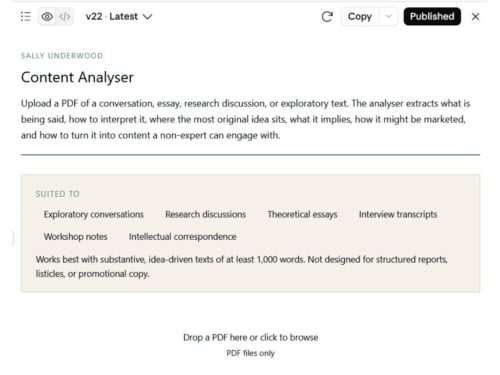
Content Analyser (Claude Artifact)
A PDF upload tool that reads a conversation document and returns six structured sections:
- Observation (detailed account of what the conversation contains),
- Interpretation (through lenses embedded in the document itself),
- The Hook (the most original or underexplored idea, with argument for why),
- Implications and Resolution (where the ideas lead and what they solve),
- Marketing Applications (targeting angles, taglines, process names), and
- Critique and Content Strategy (critical audit of confusions, plus sequencing strategy for a non-expert audience).
- A keyword/topic tag list is generated alongside the six sections.
Output is tabbed, copyable per section, and exportable in full. Built in React using the Anthropic API.
Conversation Distiller (Claude Skill)
A tool that accepts personal material — pasted text or PDF — and rewrites it in two anonymised forms: a named case study (Florence, a composite character) and an unnamed composite scenario. Both versions preserve the psychological and experiential truth of the material while removing all identifying detail, making the output safe to use in other tools, share with collaborators, or publish directly. Identified during build as a potential standalone offer with a market beyond The Analogue Project.
---
name: conversation-distiller
description: >
  Distils a conversation into four polished documents: a theoretical synthesis (PDF + DOCX)
  and a fictionalised narrative (PDF + DOCX) featuring Florence, a character who carries
  the intellectual and personal material anonymised from the conversation.
  Use whenever the user says "distil this", "run the distiller", "give me the four documents",
  "turn this into a Florence document", or references a conversation and asks for synthesis
  or narrative output. Produces exactly: [title]_synthesis.pdf, [title]_synthesis.docx,
  florence_[title].pdf, florence_[title].docx.
---

# Conversation Distiller

Produces four documents from a conversation: theoretical synthesis (PDF + DOCX) and
Florence narrative (PDF + DOCX). Read this skill fully before starting.

---

## Step 1: Extract and Organise the Raw Material

Read the conversation carefully. Extract:

**For the synthesis:**
- Theoretical positions and arguments (name the thinkers where relevant: Barrett, Jung, Szasz, von Franz)
- Critiques of frameworks or industries (Sedona Method, no-self teaching, self-help industry)
- Distinctions that matter (nourishment vs repair, constructed self vs constructing Self, subject vs object)
- Drafted content pieces (About page copy, LinkedIn posts, YouTube scripts, blog posts)
**For the Florence narrative:**
- Personal experiences that illustrate the theoretical points — anonymise fully
- Moments of rupture or recognition (e.g. an email that revealed a system's true logic)
- Clients, encounters, rooms, practices — all anonymised and fictionalised
- The emotional texture: what it felt like to be inside the methods, to leave them, to see clearly
Do not carry personal names, identifying details, or family specifics into either document.
The Florence narrative should read as fiction, not memoir.

---

## Step 2: Determine the Title

Scan the conversation for its dominant theme or the sharpest single idea.
Use this as the title root — e.g. "The Gap", "Nourishment", "The Constructing Self".
The synthesis becomes `[Title]_synthesis` and the narrative becomes `florence_[title]`.
If no clear dominant theme emerges, use the date: `YYYY-MM-DD_synthesis`.

---

## Step 3: Generate the Synthesis PDF

Use `reportlab` in Python. Install if needed:
```bash
pip install reportlab --break-system-packages -q
```

### Design specification
- Page: A4, margins 3cm all sides
- Colours: INK = #1a1a1a, ACCENT = #4a6b5a, RULE = #c8c0b0
- Body font: Times-Roman 10.5pt, leading 16, justified
- Section headings: Times-Bold 13pt, ACCENT colour, spaceBefore 20
- Title: Times-Bold 22pt, ACCENT
- Subtitle: Times-Italic 12pt, INK
- Blockquotes: Times-Italic 10.5pt, leftIndent 20
- Horizontal rules: 0.5pt, RULE colour
### Structure
Number the sections. Typical sections include (adapt to what the conversation contains):

1. The Core Framework (Barrett + Jung or whatever the theoretical spine is)
2. The Political Critique (if present)
3. Why [Method/Framework] Fails — Structurally (if present)
4. The Wound the Method Finds (if present)
5. Key Distinctions (nourishment/repair, constructed/constructing, etc.)
6. What the Practice Does
7. Drafted Content (include all copy pieces verbatim, labelled by destination)
Add, remove, or rename sections to fit the conversation. Not every conversation will
have all of these. Some will have different categories entirely.

### Output path
`/mnt/user-data/outputs/[title]_synthesis.pdf`

---

## Step 4: Generate the Florence Narrative PDF

Same `reportlab` setup. Novel register — do not summarise or explain, show through scene
and interiority.

### Design specification
- Page: A4, margins 3.5cm all sides
- Same colour palette as synthesis
- Title: Times-Bold 26pt, INK
- Subtitle: Times-Italic 13pt, ACCENT
- Chapter headings: Times-Bold 11pt, ACCENT, allCaps effect (use `.upper()` in Python),
  spaceBefore 28, spaceAfter 14
- Body: Times-Roman 11pt, leading 18, justified
- Blockquotes (Florence's internal voice or key realisations): Times-Italic 10.5pt,
  GREY (#666666), leftIndent 24, rightIndent 24
### Florence character notes
- Early forties, never stated explicitly
- Multiple degrees, diverse skills, capable of sustained sophisticated thinking
- Life feels contracted relative to what she senses is possible
- Depression is atmospheric, not dramatic — "a grey Tuesday feeling that lasted for weeks"
- Has tried the methods seriously and for years; not naive, not a victim
- The ADHD-without-naming-it quality: diverse, restless, the gap between capacity and output
- Her relationship with her own body matters (cold water, drawing, making things)
- She is the person who thinks clearly and has been failed by frameworks that couldn't
  match the quality of her thinking
### Narrative chapters
Generate one chapter per major theme or scene extracted from the conversation.
Name chapters with Roman numerals and short evocative titles (e.g. "I. The Inventory",
"IV. The Email", "IX. Nourishment").

End on something unresolved. Florence is in process. Do not give her a resolution
she hasn't earned. The last paragraph should feel like a door left open, not closed.

Leave structural room for future characters. If a chapter naturally introduces
another person (a founder, a client, a teacher), write them as a minor figure
who could be expanded later.

### Output path
`/mnt/user-data/outputs/florence_[title].pdf`

---

## Step 5: Generate Both DOCX Files

Use `docx` via Node.js. Check it is installed:
```bash
npm list -g docx 2>/dev/null | head -2
```
If not installed: `npm install -g docx`

### Design specification (both documents)
- Font: Georgia throughout
- Page: A4 (11906 x 16838 DXA), margins 1800 DXA (synthesis) or 2000 DXA (narrative)
- ACCENT colour: "4a6b5a", INK: "1a1a1a", GREY: "555555"
- Body text: size 22 (synthesis) or 23 (narrative), justified
- Never use `\n` — separate Paragraph elements only
- Never use unicode bullets
- Blockquotes: italic, indented left 480 DXA, GREY colour
- Section/chapter headings: bold, ACCENT, Georgia
### Synthesis DOCX
Mirror the PDF structure exactly. Labelled content pieces go in blockquote style.

Output: `/mnt/user-data/outputs/[title]_synthesis.docx`

### Narrative DOCX
Mirror the PDF structure exactly. Chapter titles in bold ACCENT small caps style
(use `allCaps: true` in TextRun).

Output: `/mnt/user-data/outputs/florence_[title].docx`

---

## Step 6: Present All Four Files

```python
# present_files call
filepaths = [
    "/mnt/user-data/outputs/[title]_synthesis.pdf",
    "/mnt/user-data/outputs/[title]_synthesis.docx",
    "/mnt/user-data/outputs/florence_[title].pdf",
    "/mnt/user-data/outputs/florence_[title].docx",
]
```

After presenting, note briefly:
- How many synthesis sections were generated
- How many Florence chapters
- Whether any drafted content pieces were included
- One sentence on where the narrative ends and what is left open
---

## Quality checks before presenting

- [ ] No real names in the Florence narrative
- [ ] No identifying details (specific cities named by the person, family member names, etc.)
- [ ] All four files exist and are non-zero size
- [ ] Florence narrative ends unresolved
- [ ] Synthesis includes all drafted content pieces found in the conversation
- [ ] Title is derived from the conversation's dominant idea, not generic
---

## Common failure modes to avoid

- **Generic titling**: Do not call it "Conversation Synthesis". Derive the title from the ideas.
- **Over-explaining in the narrative**: Florence shows, she does not explain. If a paragraph
  reads like a summary of the theory, rewrite it as scene or interiority.
- **Premature resolution**: Florence does not get better at the end of a chapter. She sees
  more clearly. That is different.
- **Carrying personal details**: The email anecdote becomes Florence's email. The family
  system becomes Florence's family system, unnamed. The psychiatrist becomes a doctor in
  a city, unnamed.
- **Losing the political critique**: The no-self/neoliberal argument is a spine of this
  project. If the conversation touches it, it belongs in both documents — argued in the
  synthesis, experienced in the narrative.
Next steps
Depending on client needs and goals, the next steps would be one or more of the following option:
- If all that’s required is a structured, organised summary of long unweildy conversations:
- no further actions are necessary
- If the information in the conversations is critical to corporate strategy or the knowledge base:
- The outputs must be tesed to ensure that they accuratly and consistently reflect the raw conversation contents
Project Context
A substantial workshop transcript contained explanations, participant questions, sharing, exercises and guided processes.
The material contained valuable expertise but was not structured for retrieval. Important relationships and implicit assumptions were not always made explicit.
Problem or need
Prepare the material so that it could support a source-grounded question-and-answer system. The project needed to determine:
- How the transcript should be divided
- Which content types needed separate treatment
- How related sections should be connected
- Whether retrieval returned merely relevant text or genuinely useful context
- Which implicit knowledge was missing from the source material
Complexity / challenge
- Large, nuanced body of source material
- Repeated but inconsistently explained concepts
- Implicit founder or facilitator knowledge
- Several content types
- Cross-session relationships
- Need to preserve the source while improving retrievability
- Technical and editorial decisions were interdependent
Customer or user
- New staff
- Facilitators
- Sales or customer-support staff
- People who need to interrogate complex training material
- Content owners seeking to understand what their archive contains
Deliverables
- Structured Markdown source documents
- RAG-ready document set
- Flowise proof of concept
- Retrieval tests
- Analysis of failures and knowledge gaps
- Recommendations for further preparation
- Handover documentation
- Presentation and business case
Tools and methods
- Markdown
- Flowise
- Embeddings
- Vector retrieval
- Metadata and topic labels
- Manual review
- Test questions
- Retrieval-quality evaluation
Outcomes and observations
- A working proof of concept was produced.
- Retrieval improved as more of the source material was added.
- The project revealed significant undocumented knowledge.
- The work demonstrated that document preparation was the most valuable and labour-intensive part.
- The final business case shifted toward organisational knowledge preparation and internal retrieval.
Capabilities demonstrated
Knowledge & Information Architecture: Structuring dense, unstructured conversational transcripts into coherent, tagged, and chunk-optimized schemas.
RAG Pipeline Implementation: Building, configuring, and testing end-to-end vector retrieval workflows using Flowise.
Retrieval & Answer Evaluation: Diagnosing retrieval failures, semantic drift, repetitiveness, and hallucination risks in LLM outputs.
Implicit Knowledge Extraction: Identifying unstated expert mental models, tacit assumptions, and documentation gaps required for source grounding.
Human-Centered Problem Reframing: Refocusing project objectives from generic AI tool deployment to sustainable organizational knowledge preparation.
Technical Communication & Documentation: Producing structured handover documentation, diagnostic reports, and executive business cases.
My contribution
- Manually marked up the transcript in Markdown
- Distinguished explanations, participant questions, exercises, guided processes and sharing
- Added relationships and topic labels
- Reviewed chunk size and structure
- Prepared the content for retrieval
- Built and tested a Flowise RAG prototype
- Reviewed generic, repetitive and insufficiently contextual answers
- Identified gaps caused by implicit practitioner knowledge
- Documented the process and business implications