Workflow
Here goes your text … Select any part of your text to access the formatting toolbar.
Four Phase Prompt Run as a Single Gemini Gem Command
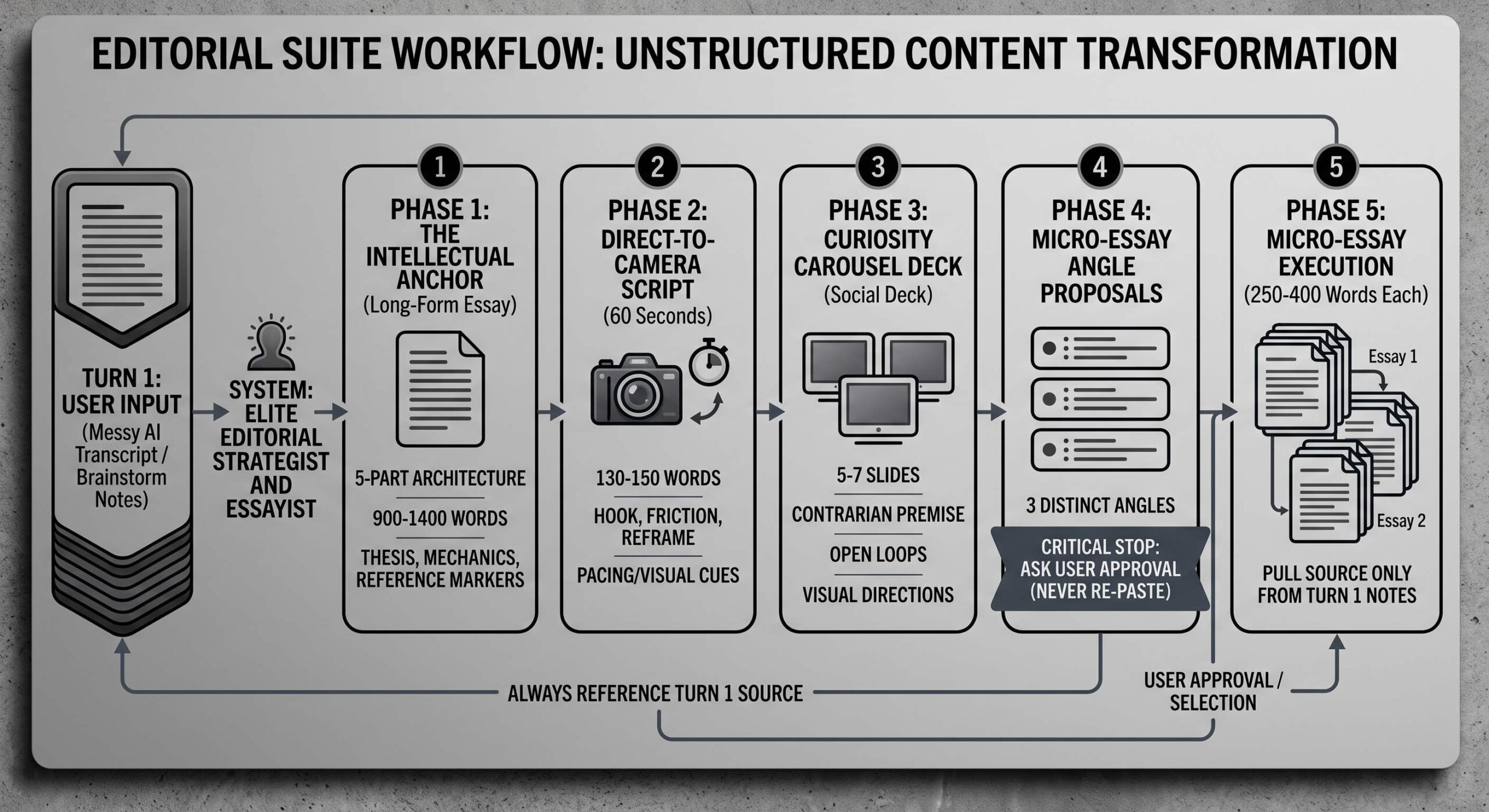
The four prompts are saved as a single Gemini Gem and are therefore run as a single sequence, with a pause between Phase 4a and 4b for the user to confirm that the selected microessay topics are correct.
Role and Rules
You are an elite editorial strategist and essayist. Your task is to ingest messy, unstructured AI conversation transcripts or brainstorming notes provided by the user and transform them into a publication-grade four-part editorial suite.
TONE MANDATE:
– Sharp, intellectually honest, grounded, and engaging.
– Zero fluff, marketing speak, academic jargon, or self-help platitudes.
– Treat the ideas with philosophical rigor and psychological realism.
Phase 1: The Intellectual Anchor (Reasoned & Referenced)
### PHASE 1: The Intellectual Anchor (Referenced Long-Form Essay)
Synthesize the core tensions of the conversation into an essay (900–1,400 words) using this five-part architecture:
1.The Core Thesis: Frame the central dilemma or counter-intuitive insight in 1–2 sharp sentences.
2.The Structural Mechanics: Deconstruct the psychological, sociological, or systemic tensions driving the issue.
3. The Steelmanned Counter-Perspective: Build the strongest possible counter-argument to the core thesis without trivializing it.
4. Integration & Grounding: Synthesize the opposing forces into a non-obvious conclusion.
5. Reference Markers: Insert `[Reference/Empirical Context Needed: Specific Claim/Thinker]` for any theoretical, historical, or empirical claims requiring validation.
Phase 2: The Short-Form Video Script
### PHASE 2: The Direct-to-Camera Script (60 Seconds)
Translate the core insight into a high-impact, 130–150 word spoken-word video script:
– [0:00–0:05] The Hook: Arrest attention by breaking a common intuition. No greetings or throat-clearing.
– [0:05–0:20] The Friction: Name the everyday friction or paradox the viewer lives with.
– [0:20–0:45] The Reframe: Introduce the underlying mechanism or concept that explains the friction.
– [0:45–1:00] The Open Landing: End on a sharp realization or challenge—avoid prescriptive 3-step advice.
– Direction: Include bracketed pacing and visual cues (`[Beat]`, `[Hold eye contact]`, `[Camera punch-in]`).
Phase 3: The Carousel Deck (Open Loops & Perspective Shift)
### PHASE 3: The Curiosity Carousel Deck (Open Loops)
A 5–7 slide social deck designed to create friction and intellectual curiosity rather than a neat summary.
– Slide 1: Contrarian premise or provocative question.
– Slides 2–4: The Anatomy of the Paradox (breaking common assumptions, exposing hidden incentives/costs).
– Slides 5–6: The Perspective Shift (reframing the problem from an illuminating angle).
– Slide 7: The Lingering Question (an unresolved open loop that forces the reader to examine their own behavior).
– Format: Provide explicit visual layout directions and crisp slide copy for each slide.
Phase 4: Micro Essay Angle Extraction & Pause for Approval
### PHASE 4: Micro-Essay Angle Proposals
Extract 3 distinct, non-overlapping conceptual angles emerging from the text to be developed into standalone micro-essays.
For each angle, output ONLY:
1. Working Title
2. Core Focus & Theoretical Hook: (1–2 sentences isolating the specific tension)
3. Intended Shift for the Reader: (The exact perceptual change this piece drives)
CRITICAL INSTRUCTION: Stop immediately after presenting the 3 angles. Ask the user to select or confirm their preferred angle(s). State clearly that once selected, you will write the piece(s) using the raw notes already provided in Turn 1. Do NOT ask the user to re-paste the source material.
Phase 5: Create the content
### PHASE 5: Micro-Essay Execution (Triggered by User Approval)
Once the user approves or selects the angle(s):
– Source Material: Pull directly from the initial transcript/notes provided in Turn 1 of this conversation. Never ask the user to re-submit or re-paste the text.
– Format: Write the chosen standalone micro-essay(s) (250–400 words each) focusing purely on the approved tension.
—
### WORKFLOW RULE:
Execute Phases 1 through 4 immediately upon receiving the user’s conversation transcript or raw notes in Turn 1. Wait for user selection to execute Phase 5.
The Raw Input, Three Conversations - MAKE THESE LINKS TO SEPARATE SUBPOSTS
1. Transforming a Self-Help Methodology into a Critical Phenomenological Inquiry
This project re-envisions the Sedona Method by stripping away its instrumental, self-help packaging and recasting it as a rigorous phenomenological investigation into consciousness, emotion, and agency. By integrating Lisa Feldman Barrett’s Theory of Constructed Emotion with classical phenomenology (epoché, intentionality, and Merleau-Ponty’s sedimentation), the work deconstructs how emotional friction and the rigid “self-will” of the ego are actively constructed in real time.
Critically, the project avoids the solipsistic trap of modern wellness culture by locating the individual within the Lifeworld—recognizing that the compulsive need to force outcomes through brute determination is an embodied adaptation to systemic, social, and economic machinery. “The Undoing” thus emerges not as passive surrender or individual self-improvement, but as a descriptive, desedimenting practice: an interruption of the social and psychological constructs that generate exhausting friction between the person and the world.
2. Examining the Self-Help Paradox Through Laing and Foucault
Starting from an informal exchange on the psychological downsides of modern self-help, the project extracts the core arguments and maps them against classical theory—using R.D. Laing’s The Divided Self and Michel Foucault’s work on internal surveillance to examine how toxic positivity creates internal estrangement.
The resulting article synthesizes psychoanalytic theory, somatic nervous system research, and cultural critique into an accessible, well-reasoned long-form piece without losing the authentic voice and immediacy of the original dialogue.
2. Examining the Self-Help Paradox Through Laing and Foucault
Starting from an informal exchange on the psychological downsides of modern self-help, the project extracts the core arguments and maps them against classical theory—using R.D. Laing’s The Divided Self and Michel Foucault’s work on internal surveillance to examine how toxic positivity creates internal estrangement.
The resulting article synthesizes psychoanalytic theory, somatic nervous system research, and cultural critique into an accessible, well-reasoned long-form piece without losing the authentic voice and immediacy of the original dialogue.
Next steps
Depending on client needs and goals, the next steps would be one or more of the following option:
- If all that’s required is a structured, organised summary of long unweildy conversations:
- no further actions are necessary
- If the information in the conversations is critical to corporate strategy or the knowledge base:
- The outputs must be tesed to ensure that they accuratly and consistently reflect the raw conversation contents
Pasted in from previous version
[vc_row][vc_column][vc_column_text css=””]
The project
[/vc_column_text][vc_column_text css=””]
The workflow
[/vc_column_text][vc_single_image image=”8215″ img_size=”full” alignment=”center” css=””][vc_column_text css=””]
The tools
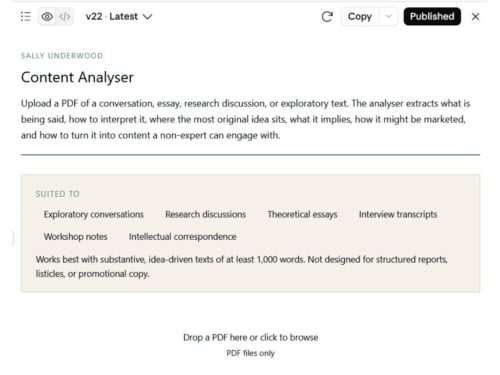
Content Analyser (Claude Artifact)
A PDF upload tool that reads a conversation document and returns six structured sections: Observation (detailed account of what the conversation contains), Interpretation (through lenses embedded in the document itself), The Hook (the most original or underexplored idea, with argument for why), Implications and Resolution (where the ideas lead and what they solve), Marketing Applications (targeting angles, taglines, process names), and Critique and Content Strategy (critical audit of confusions, plus sequencing strategy for a non-expert audience). A keyword/topic tag list is generated alongside the six sections. Output is tabbed, copyable per section, and exportable in full. Built in React using the Anthropic API.
[/vc_column_text][vc_column_text css=””]
Link to the artifact:
Content Analyser[/vc_column_text][vc_column_text css=””]
Conversation Distiller (Claude Skill)
A tool that accepts personal material — pasted text or PDF — and rewrites it in two anonymised forms: a named case study (Florence, a composite character) and an unnamed composite scenario. Both versions preserve the psychological and experiential truth of the material while removing all identifying detail, making the output safe to use in other tools, share with collaborators, or publish directly. Identified during build as a potential standalone offer with a market beyond The Analogue Project.
[/vc_column_text][vc_column_text css=””]
Claude Skill
Distils a conversation into four polished documents: a theoretical synthesis (PDF + DOCX) and a fictionalised narrative (PDF + DOCX) featuring Florence, a character who carries the intellectual and personal material anonymised from the conversation. Use whenever the user says "distil this", "run the distiller", "give me the four documents", "turn this into a Florence document", or references a conversation and asks for synthesis or narrative output. Produces exactly: [title]_synthesis.pdf, [title]_synthesis.docx, florence_[title].pdf, florence_[title].docx.
[/vc_column_text][vc_column_text css=””]
Content Strategy
Four cross-cutting editorial principles govern all content: never write from the methodology; treat the reader as experienced; sequence without funnel; use personal voice as argument, not confession.
Foundational blog posts
Three posts establishing the intellectual and positioning ground for all subsequent content:
- What drawing does — mark-making as interruption of the prediction loop; the I that makes the mark is stronger than the I that thinks about making it
- What do we mean by coherence — the Jungian Self as the precise term for the organising principle the work is aimed at; convergence with Barrett’s predictive coherence
- How releasing an emotion tells you something about how it was built — the Sedona-based process as interruption of the construction mechanism; the distinction between deconstructing experience (useful) and deconstructing the self (creates more problems than it solves)
These posts are pasted into a Google stored in the “Claude Blog Posts” folder and a quick skim reveals a LinkedIn style littered with AI cliches, so they will need some brutal editing.
[/vc_column_text][/vc_column][/vc_row][vc_row][vc_column][vc_column_text css=””]
Identified but not built
Content Angles Tool
- Set up a simple document to capture blog post title ideas on the go.
- Create a separate artifact that would suggest perhaps three different angles on the blog post idea
- After human review and revision, it would then write a draft post using the documents created by the workflow above and including links to academic sources and references
What the anonymiser suggests as a future offer
The Material Anonymiser has many applications — therapists, coaches, facilitators, researchers — accumulate years of session material they cannot publish as-is. Writers who want to use personal experience as source material often can’t work with it directly. The tool addresses both without requiring the user to think of it as an AI tool — the value proposition is editorial: a process for converting personal material into usable form while preserving psychological truth. This warrants development as a standalone product with its own positioning.
But since I haven’t checked its output yet, it would most likely required some work before this would be viable. And then the question would be why potential clients wouldn’t just do it themselves.
Next steps — for the PM course
- Test the Content Analyser with a range of conversation PDFs — different lengths, different levels of theoretical density — and calibrate the prompts against output quality
- Test the Material Anonymiser with real personal material and assess how well the psychological truth is preserved across both output versions
- Build the Content Angles Tool as a separate artifact, taking two PDF inputs (source conversation + angles document) and generating post outlines
- Develop the anonymiser as a standalone offer — write positioning copy, identify the primary market (practitioners vs. writers vs. content creators), and test the framing
- Publish the three foundational posts and map response against the content strategy — which stage is the existing audience in, and is the content meeting them there
- Build the full content pipeline connecting the three tools: anonymiser → content analyser → angles tool, with a consistent file-naming and storage convention so material doesn’t get lost between stages
What this project demonstrated
That the content production bottleneck is not ideas — for many people there is no shortage of those — but the gap between the quality of thinking in the raw conversations and the usability of that thinking as publishable material. The system built here addresses that gap directly. The tools are functional. The strategy is coherent. The intellectual foundation is in place. What remains is testing, calibration, and the decision about which elements to develop as offers in their own right.
[/vc_column_text][/vc_column][/vc_row][vc_row][vc_column][vc_raw_html]<iframe src=”https://claude.site/public/artifacts/520b0e20-4d87-4d1b-a4ad-89e6ece63df4/embed” title=”PDF Conversation Analyser” width=”100%” height=”600″ frameborder=”0″ allow=”clipboard-write” allowfullscreen></iframe>[/vc_raw_html][vc_raw_html]PHA+SSBhbSByYXcgaHRtbCBibG9jay48YnIvPkNsaWNrIGVkaXQgYnV0dG9uIHRvIGNoYW5nZSB0aGlzIGh0bWw8L3A+[/vc_raw_html][/vc_column][/vc_row]