How it works
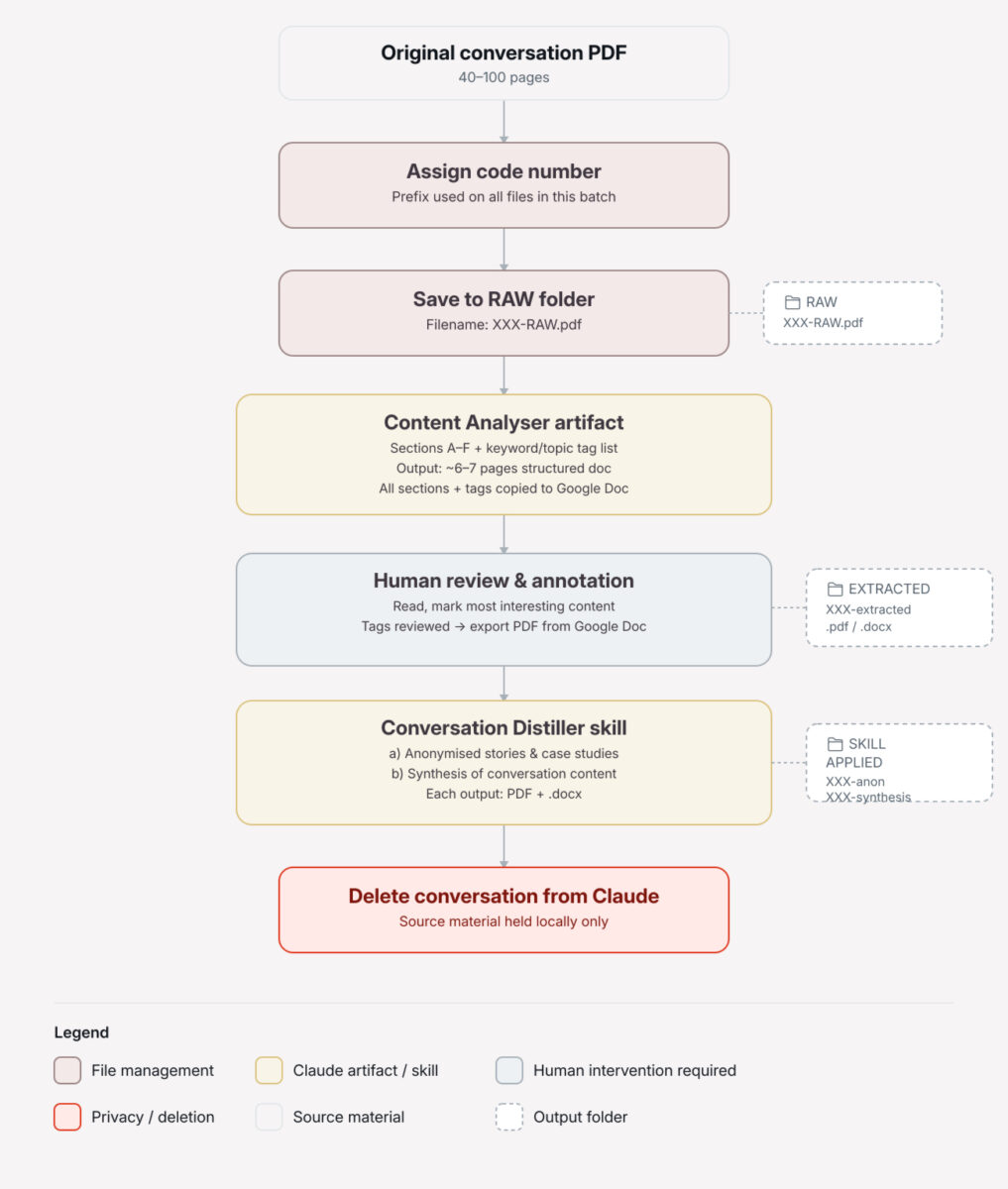
Elements
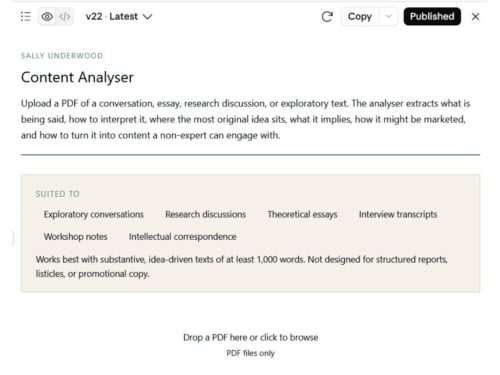
Content Analyser (Claude Artifact)
A PDF upload tool that reads a conversation document and returns six structured sections:
- Observation (detailed account of what the conversation contains),
- Interpretation (through lenses embedded in the document itself),
- The Hook (the most original or underexplored idea, with argument for why),
- Implications and Resolution (where the ideas lead and what they solve),
- Marketing Applications (targeting angles, taglines, process names), and
- Critique and Content Strategy (critical audit of confusions, plus sequencing strategy for a non-expert audience).
- A keyword/topic tag list is generated alongside the six sections.
Output is tabbed, copyable per section, and exportable in full. Built in React using the Anthropic API.
Content Analyser Prompt
Paste this into a new chat along with your conversation PDF (upload it directly — no need to paste the text) to get the same six-section breakdown the artifact produces, without hitting any long-context billing limits.
Prompt to use:
You are an analytical editorial assistant. I’m going to give you a long conversation document. Analyse it and return the following six sections, each clearly headed. Be thorough and detailed — this is for editorial and content development purposes, not a quick summary.
Section A — Observation A detailed, faithful account of what the conversation contains: the core questions, concepts, and ideas raised. Structure this with subheadings (using ## for each theme or topic area) and bullet points under each. Include specific language, frameworks, and distinctions actually used in the conversation — don’t generalise or paraphrase away the precision. At least 200 words.
Section B — Interpretation through embedded lenses Identify which frameworks, lenses, or ways of seeing are already present in the conversation itself (e.g. named theories, methodologies, or ways of framing a problem that I introduced or that emerged in the discussion). Read the material through those lenses. Do not impose external frameworks that aren’t already present in the text. At least 150 words.
Section C — The Hook Identify the single most original, surprising, or underexplored idea in the text — something that cuts through, reframes, or resolves something others haven’t noticed. This is the editorial payload of the whole piece. Be specific and argue for why this is the hook, not just what it is. At least 100 words.
Section D — Implications & Resolution Where these ideas lead. What problem they solve or open up. What a piece of writing built around this material could actually argue. Include what is resolved and what remains open. At least 150 words.
Section E — Marketing Applications Practical marketing applications drawn from the material: (1) targeting angles — who this speaks to and how to frame an offer around it, (2) 3–5 potential taglines or hooks, (3) suggested names for any processes, methods, or frameworks that emerge from the material.
Section F — Critique & Content Strategy Two parts. First, a critical audit of the discussion itself: identify where the thinking is circular, under-defined, contradictory, or likely to confuse a reader who wasn’t part of the conversation — flag specific terms or claims. Second, a concrete content strategy for turning this material into something a non-expert audience can engage with: what to lead with, what to leave out or reframe, what order the ideas should be introduced in, and what the reader needs to be told first before the more complex ideas will land.
Keywords Finish with a flat list of 8–15 single words or short phrases (2–3 words max) tagging the key topics, people, concepts, disciplines, and proper nouns in the document — useful for filing and searching.
Notes on use
- Upload the conversation PDF directly to the chat rather than pasting the text — this keeps the request within normal usage rather than triggering long-context pricing
- If the document is very long, you can ask me to focus on a specific section or range of the conversation first, then run it again on the remainder
- The output will come back as plain formatted text rather than a tabbed interface, but you can copy the whole response straight into Google Docs for your Extracted folder step
Conversation Distiller (Claude Skill)
A tool that accepts personal material — pasted text or PDF — and rewrites it in two anonymised forms: a named case study (Florence, a composite character) and an unnamed composite scenario. Both versions preserve the psychological and experiential truth of the material while removing all identifying detail, making the output safe to use in other tools, share with collaborators, or publish directly. Identified during build as a potential standalone offer with a market beyond The Analogue Project.
—
name: conversation-distiller
description: >
Distils a conversation into four polished documents: a theoretical synthesis (PDF + DOCX)
and a fictionalised narrative (PDF + DOCX) featuring Florence, a character who carries
the intellectual and personal material anonymised from the conversation.
Use whenever the user says “distil this”, “run the distiller”, “give me the four documents”,
“turn this into a Florence document”, or references a conversation and asks for synthesis
or narrative output. Produces exactly: [title]_synthesis.pdf, [title]_synthesis.docx,
florence_[title].pdf, florence_[title].docx.
—
# Conversation Distiller
Produces four documents from a conversation: theoretical synthesis (PDF + DOCX) and
Florence narrative (PDF + DOCX). Read this skill fully before starting.
—
## Step 1: Extract and Organise the Raw Material
Read the conversation carefully. Extract:
**For the synthesis:**
– Theoretical positions and arguments (name the thinkers where relevant: Barrett, Jung, Szasz, von Franz)
– Critiques of frameworks or industries (Sedona Method, no-self teaching, self-help industry)
– Distinctions that matter (nourishment vs repair, constructed self vs constructing Self, subject vs object)
– Drafted content pieces (About page copy, LinkedIn posts, YouTube scripts, blog posts)
**For the Florence narrative:**
– Personal experiences that illustrate the theoretical points — anonymise fully
– Moments of rupture or recognition (e.g. an email that revealed a system’s true logic)
– Clients, encounters, rooms, practices — all anonymised and fictionalised
– The emotional texture: what it felt like to be inside the methods, to leave them, to see clearly
Do not carry personal names, identifying details, or family specifics into either document.
The Florence narrative should read as fiction, not memoir.
—
## Step 2: Determine the Title
Scan the conversation for its dominant theme or the sharpest single idea.
Use this as the title root — e.g. “The Gap”, “Nourishment”, “The Constructing Self”.
The synthesis becomes `[Title]_synthesis` and the narrative becomes `florence_[title]`.
If no clear dominant theme emerges, use the date: `YYYY-MM-DD_synthesis`.
—
## Step 3: Generate the Synthesis PDF
Use `reportlab` in Python. Install if needed:
“`bash
pip install reportlab –break-system-packages -q
“`
### Design specification
– Page: A4, margins 3cm all sides
– Colours: INK = #1a1a1a, ACCENT = #4a6b5a, RULE = #c8c0b0
– Body font: Times-Roman 10.5pt, leading 16, justified
– Section headings: Times-Bold 13pt, ACCENT colour, spaceBefore 20
– Title: Times-Bold 22pt, ACCENT
– Subtitle: Times-Italic 12pt, INK
– Blockquotes: Times-Italic 10.5pt, leftIndent 20
– Horizontal rules: 0.5pt, RULE colour
### Structure
Number the sections. Typical sections include (adapt to what the conversation contains):
1. The Core Framework (Barrett + Jung or whatever the theoretical spine is)
2. The Political Critique (if present)
3. Why [Method/Framework] Fails — Structurally (if present)
4. The Wound the Method Finds (if present)
5. Key Distinctions (nourishment/repair, constructed/constructing, etc.)
6. What the Practice Does
7. Drafted Content (include all copy pieces verbatim, labelled by destination)
Add, remove, or rename sections to fit the conversation. Not every conversation will
have all of these. Some will have different categories entirely.
### Output path
`/mnt/user-data/outputs/[title]_synthesis.pdf`
—
## Step 4: Generate the Florence Narrative PDF
Same `reportlab` setup. Novel register — do not summarise or explain, show through scene
and interiority.
### Design specification
– Page: A4, margins 3.5cm all sides
– Same colour palette as synthesis
– Title: Times-Bold 26pt, INK
– Subtitle: Times-Italic 13pt, ACCENT
– Chapter headings: Times-Bold 11pt, ACCENT, allCaps effect (use `.upper()` in Python),
spaceBefore 28, spaceAfter 14
– Body: Times-Roman 11pt, leading 18, justified
– Blockquotes (Florence’s internal voice or key realisations): Times-Italic 10.5pt,
GREY (#666666), leftIndent 24, rightIndent 24
### Florence character notes
– Early forties, never stated explicitly
– Multiple degrees, diverse skills, capable of sustained sophisticated thinking
– Life feels contracted relative to what she senses is possible
– Depression is atmospheric, not dramatic — “a grey Tuesday feeling that lasted for weeks”
– Has tried the methods seriously and for years; not naive, not a victim
– The ADHD-without-naming-it quality: diverse, restless, the gap between capacity and output
– Her relationship with her own body matters (cold water, drawing, making things)
– She is the person who thinks clearly and has been failed by frameworks that couldn’t
match the quality of her thinking
### Narrative chapters
Generate one chapter per major theme or scene extracted from the conversation.
Name chapters with Roman numerals and short evocative titles (e.g. “I. The Inventory”,
“IV. The Email”, “IX. Nourishment”).
End on something unresolved. Florence is in process. Do not give her a resolution
she hasn’t earned. The last paragraph should feel like a door left open, not closed.
Leave structural room for future characters. If a chapter naturally introduces
another person (a founder, a client, a teacher), write them as a minor figure
who could be expanded later.
### Output path
`/mnt/user-data/outputs/florence_[title].pdf`
—
## Step 5: Generate Both DOCX Files
Use `docx` via Node.js. Check it is installed:
“`bash
npm list -g docx 2>/dev/null | head -2
“`
If not installed: `npm install -g docx`
### Design specification (both documents)
– Font: Georgia throughout
– Page: A4 (11906 x 16838 DXA), margins 1800 DXA (synthesis) or 2000 DXA (narrative)
– ACCENT colour: “4a6b5a”, INK: “1a1a1a”, GREY: “555555”
– Body text: size 22 (synthesis) or 23 (narrative), justified
– Never use `\n` — separate Paragraph elements only
– Never use unicode bullets
– Blockquotes: italic, indented left 480 DXA, GREY colour
– Section/chapter headings: bold, ACCENT, Georgia
### Synthesis DOCX
Mirror the PDF structure exactly. Labelled content pieces go in blockquote style.
Output: `/mnt/user-data/outputs/[title]_synthesis.docx`
### Narrative DOCX
Mirror the PDF structure exactly. Chapter titles in bold ACCENT small caps style
(use `allCaps: true` in TextRun).
Output: `/mnt/user-data/outputs/florence_[title].docx`
—
## Step 6: Present All Four Files
“`python
# present_files call
filepaths = [
“/mnt/user-data/outputs/[title]_synthesis.pdf”,
“/mnt/user-data/outputs/[title]_synthesis.docx”,
“/mnt/user-data/outputs/florence_[title].pdf”,
“/mnt/user-data/outputs/florence_[title].docx”,
]
“`
After presenting, note briefly:
– How many synthesis sections were generated
– How many Florence chapters
– Whether any drafted content pieces were included
– One sentence on where the narrative ends and what is left open
—
## Quality checks before presenting
– [ ] No real names in the Florence narrative
– [ ] No identifying details (specific cities named by the person, family member names, etc.)
– [ ] All four files exist and are non-zero size
– [ ] Florence narrative ends unresolved
– [ ] Synthesis includes all drafted content pieces found in the conversation
– [ ] Title is derived from the conversation’s dominant idea, not generic
—
## Common failure modes to avoid
– **Generic titling**: Do not call it “Conversation Synthesis”. Derive the title from the ideas.
– **Over-explaining in the narrative**: Florence shows, she does not explain. If a paragraph
reads like a summary of the theory, rewrite it as scene or interiority.
– **Premature resolution**: Florence does not get better at the end of a chapter. She sees
more clearly. That is different.
– **Carrying personal details**: The email anecdote becomes Florence’s email. The family
system becomes Florence’s family system, unnamed. The psychiatrist becomes a doctor in
a city, unnamed.
– **Losing the political critique**: The no-self/neoliberal argument is a spine of this
project. If the conversation touches it, it belongs in both documents — argued in the
synthesis, experienced in the narrative.
Next steps
Depending on client needs and goals, the next steps would be one or more of the following option:
- If all that’s required is a structured, organised summary of long unweildy conversations:
- no further actions are necessary
- If the information in the conversations is critical to corporate strategy or the knowledge base:
- The outputs must be tesed to ensure that they accuratly and consistently reflect the raw conversation contents
Project Context
Long, exploratory coaching and theoretical conversations contained deep intellectual substance, nuanced frameworks, and personal case studies. However, the raw transcripts were unwieldy, unpublishable, and contained sensitive identifying details that could not be shared directly with collaborators or public audiences.
Problem or need
Design a reproducible content pipeline to extract publishable, market-ready material from complex conversational content without diluting intellectual rigor or compromising confidentiality. The project needed to resolve:
- How to automatically extract high-value insights, marketing angles, and editorial critiques from dense conversations.
- How to systematically anonymize sensitive personal narratives while preserving their psychological and experiential truth.
- How to structure multi-stage outputs (analysis, theoretical synthesis, narrative case studies, and content drafts) into consistent, reusable document formats (PDF and DOCX).
- How to avoid common AI failure modes, such as cliché marketing copy, generic summarization, and premature resolution in creative narratives.
Complexity / Challenges
- Preserving emotional texture and psychological truth during rigorous de-identification.
- Balancing dual output requirements: highly rigorous theoretical synthesis vs. literary, scene-driven narrative voice.
- Managing programmatic document generation across both Python (reportlab) and Node.js (docx) environments with strict typographic rules.
- Mitigating LLM-generated platitudes and enforcing critical self-audits within automated outputs.
Customer or user
- Coaches, Therapists, and Facilitators: Practitioners holding years of sensitive client transcripts needing anonymized case studies and thought-leadership assets.
- Writers and Researchers: Creators translating long-form exploratory thinking into structured publications.
- Content Strategy and Editorial Teams: Operators needing rapid structural audits, hook identification, and critique of raw material.
Deliverables
- Content Analyser React Artifact: Interactive tool with tabbed UI, PDF ingestion, per-section copying, and full export.
- Conversation Distiller Skill & Scripts: Programmatic pipeline producing 4 standardized deliverables per run ([title]_synthesis.pdf, [title]_synthesis.docx, [narrative]_[title].pdf,
[narrative]_[title].docx). - Editorial Prompt Framework: Source prompts engineered for zero-data-leakage analysis and long-context processing.
- Foundational Content Drafts: 3 core conceptual essays establishing the theoretical grounding of the body of work.
- Pipeline Architecture & Future Roadmap: Specifications for end-to-end chaining (Anonymizer $\to$ Analyzer $\to$ Angles Tool).
Tools and methods
- Anthropic Claude API & Claude Artifacts
- ReactPython (reportlab for PDF compilation)
- Node.js (docxlibrary for styled Word output)
- Prompt Engineering (multi-shot, persona framing, structural enforcement)
- Information Architecture & Editorial Design
- Privacy & Anonymization Structuring
Outcomes and observations
- Successfully demonstrated automated translation of complex, multi-hour conversational transcripts into structured editorial assets within minutes.
- Reduced extraction friction by separating high-level hook discovery, critical auditing, and narrative drafting into discrete automated workflows.
- Proved that automated anonymization could generate compelling case study narratives without revealing private client information.
- Established a scalable blueprint for end-to-end conversational knowledge management.
Capabilities demonstrated
- Content operations system architecture
- Advanced prompt engineering & LLM chaining
- Programmatic document generation (PDF/DOCX)
- Product & UI prototyping (React Artifacts)
- Editorial strategy & critical analysis
- Anonymization and ethical data handling
My contribution
- Architected a three-stage AI-assisted content operations pipeline converting raw conversations into structured editorial assets.
- Built and deployed the Content Analyser Claude Artifact using React and the Anthropic API, establishing a 6-part editorial analysis framework (Observation, Embedded Lenses, The Hook, Implications, Marketing Applications, Critique & Content Strategy) plus keyword indexing.
- Developed the Conversation Distiller skill, automating the dual generation of theoretical syntheses and fictionalized case narratives (Florence) across PDF (reportlab) and DOCX (docx via Node.js).
- Designed prompt constraints to eliminate identifying details, prevent AI clichés, and maintain strict narrative and typographic styling standards.
- Formulated core content strategy principles and drafted foundational pillar content based on extracted theoretical frameworks.
- Outlined the technical specification for an upstream Content Angles Tool and evaluated the commercial viability of a standalone anonymization product.
Link to notion entry
Project Context
[TEXT]
Problem or need
[TEXT]
Complexity / challenges
- [TEXT]
Customer or user
- [TEXT]
Deliverables
- [TEXT]
Tools and methods
- [TEXT]
Outcomes and observations
- [TEXT]
Capabilities demonstrated
- [TEXT]
My contribution
- [TEXT]