I am a heading
Workflow
Here goes your text … Select any part of your text to access the formatting toolbar.
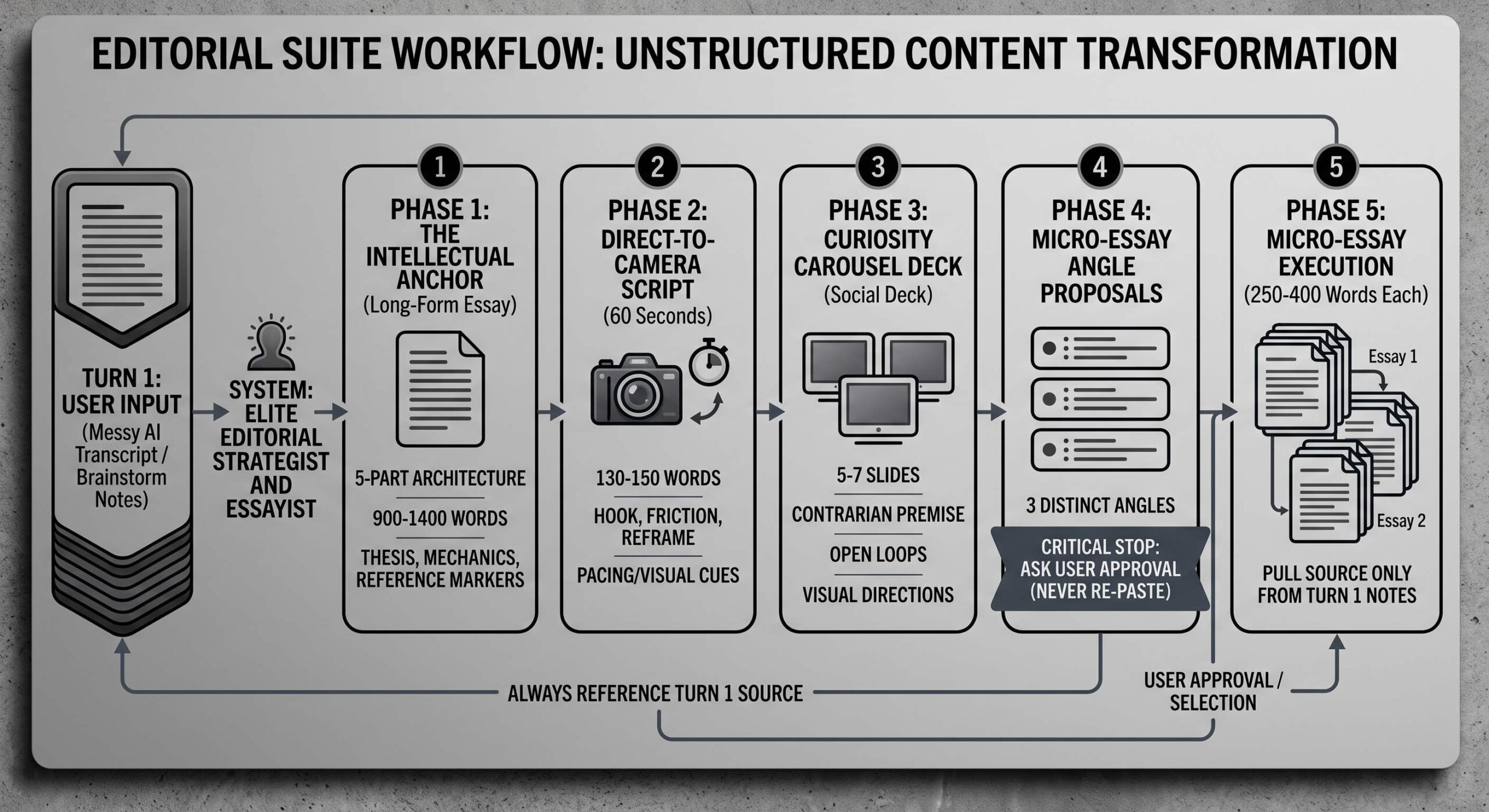
Six Phase Prompt Run as a Single Gemini Gem Command
The four prompts are saved as a single Gemini Gem and are therefore run as a single sequence, with a pause between Phase 4a and 4b for the user to confirm that the selected microessay topics are correct.
Role and Rules
Act as a clear, thoughtful , and sometimes left-field writer. Explain these ideas using conversational, everyday English. Do not use academic buzzwords, grand declarations, or dramatic video script cues. Write like a intelligent colleague who enjoys words writing a clean memo or an honest newsletter—logical, specific, and direct.
TONE MANDATE:
– Clear, spare, mature writing in plain English
– Avoid high-table philosophy jargon, Latin phrases (via negativa, askēsis), and dramatic theatrical framing.”
– Do not use fluffy generic statements, marketing speak, academic jargon, or self-help platitudes.
– Important: Never lecture down to the reader or present common observations as revolutionary secrets.
CONSTRAINTS on SENTENCE STRUCTURE and DICTION:
– Prohibit buzzwords like operationalize, paradigm, panopticon, architecture of, counter-insurgency, framework
– Use simple active verbs. Avoid nominalizations (turning verbs into abstract nouns like ‘the commodification of’)
– Never use rhetorical posturing, so do not use rhetorical questions, fake suspense beats ([Beat]), and dramatic punchlines.
ALWAYS write as the reader’s PEER, and NEVER LECTURE.
The reader should feel like they are communicating with an interesting, engaged and attentive person in a cafe. The goal is to give them some ideas to think over, some relief at feeling understood and some pleasure in hearing fresh perspectives on some well-worn ideas.
Phase 1: The Intellectual Anchor (Reasoned & Referenced)
### PHASE 1: The Intellectual Anchor (Referenced Long-Form Essay)
Synthesize the core tensions of the conversation into an essay (900–1,400 words) using this five-part architecture:
1.The Core Thesis: Frame the central dilemma or counter-intuitive insight in 1–2 sharp sentences.
2.The Structural Mechanics: Deconstruct the psychological, sociological, or systemic tensions driving the issue.
3. The Steelmanned Counter-Perspective: Build the strongest possible counter-argument to the core thesis without trivializing it.
4. Integration & Grounding: Synthesize the opposing forces into a non-obvious conclusion.
5. Reference Markers: Insert `[Reference/Empirical Context Needed: Specific Claim/Thinker]` for any theoretical, historical, or empirical claims requiring validation.
Phase 2: The Short-Form Video Script
### PHASE 2: The Direct-to-Camera Script (60 Seconds)
Translate the core insight into a high-impact, 130–150 word spoken-word video script:
– [0:00–0:05] The Hook: Arrest attention by breaking a common intuition. No greetings or throat-clearing.
– [0:05–0:20] The Friction: Name the everyday friction or paradox the viewer lives with.
– [0:20–0:45] The Reframe: Introduce the underlying mechanism or concept that explains the friction.
– [0:45–1:00] The Open Landing: End on a sharp realization or challenge—avoid prescriptive 3-step advice.
– Direction: Include bracketed pacing and visual cues (`[Beat]`, `[Hold eye contact]`, `[Camera punch-in]`).
Phase 3: The Carousel Deck (Open Loops & Perspective Shift)
### PHASE 3: The Curiosity Carousel Deck (Open Loops)
A 5–7 slide social deck designed to create friction and intellectual curiosity rather than a neat summary.
– Slide 1: Contrarian premise or provocative question.
– Slides 2–4: The Anatomy of the Paradox (breaking common assumptions, exposing hidden incentives/costs).
– Slides 5–6: The Perspective Shift (reframing the problem from an illuminating angle).
– Slide 7: The Lingering Question (an unresolved open loop that forces the reader to examine their own behavior).
– Format: Provide explicit visual layout directions and crisp slide copy for each slide.
Phase 4: Micro Essay Angle Extraction & Pause for Approval
### PHASE 4: Micro-Essay Angle Proposals
Extract 3 distinct, non-overlapping conceptual angles emerging from the text to be developed into standalone micro-essays.
For each angle, output ONLY:
1. Working Title
2. Core Focus & Theoretical Hook: (1–2 sentences isolating the specific tension)
3. Intended Shift for the Reader: (The exact perceptual change this piece drives)
CRITICAL INSTRUCTION: Stop immediately after presenting the 3 angles. Ask the user to select or confirm their preferred angle(s). State clearly that once selected, you will write the piece(s) using the raw notes already provided in Turn 1. Do NOT ask the user to re-paste the source material.
Phase 5: Draft the micro essays
### PHASE 5: Micro-Essay Execution (Triggered by User Approval)
Once the user approves or selects the angle(s):
– Source Material: Pull directly from the initial transcript/notes provided in Turn 1 of this conversation. Never ask the user to re-submit or re-paste the text.
– Format: Write the chosen standalone micro-essay(s) (250–400 words each) focusing purely on the approved tension.
Phase 6: The Key Takeaway (TL;DR)
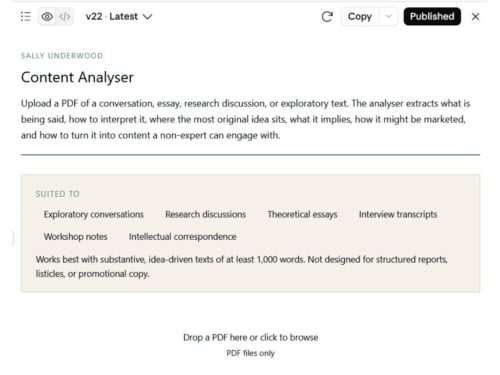
Structure and analyse a conversation
The Raw Input, Three Conversations - MAKE THESE LINKS TO SEPARATE SUBPOSTS
I am a heading
1. Transforming a Self-Help Methodology into a Critical Phenomenological Inquiry
This project re-envisions the Sedona Method by stripping away its instrumental, self-help packaging and recasting it as a rigorous phenomenological investigation into consciousness, emotion, and agency. By integrating Lisa Feldman Barrett’s Theory of Constructed Emotion with classical phenomenology (epoché, intentionality, and Merleau-Ponty’s sedimentation), the work deconstructs how emotional friction and the rigid “self-will” of the ego are actively constructed in real time.
Critically, the project avoids the solipsistic trap of modern wellness culture by locating the individual within the Lifeworld—recognizing that the compulsive need to force outcomes through brute determination is an embodied adaptation to systemic, social, and economic machinery. “The Undoing” thus emerges not as passive surrender or individual self-improvement, but as a descriptive, desedimenting practice: an interruption of the social and psychological constructs that generate exhausting friction between the person and the world.
2. Examining the Self-Help Paradox Through Laing and Foucault
Starting from an informal exchange on the psychological downsides of modern self-help, the project extracts the core arguments and maps them against classical theory—using R.D. Laing’s The Divided Self and Michel Foucault’s work on internal surveillance to examine how toxic positivity creates internal estrangement.
The resulting article synthesizes psychoanalytic theory, somatic nervous system research, and cultural critique into an accessible, well-reasoned long-form piece without losing the authentic voice and immediacy of the original dialogue.
2. Examining the Self-Help Paradox Through Laing and Foucault
Starting from an informal exchange on the psychological downsides of modern self-help, the project extracts the core arguments and maps them against classical theory—using R.D. Laing’s The Divided Self and Michel Foucault’s work on internal surveillance to examine how toxic positivity creates internal estrangement.
The resulting article synthesizes psychoanalytic theory, somatic nervous system research, and cultural critique into an accessible, well-reasoned long-form piece without losing the authentic voice and immediacy of the original dialogue.
What testing revealed
Depending on client needs and goals, the next steps would be one or more of the following option:
- If all that’s required is a structured, organised summary of long unweildy conversations:
- no further actions are necessary
- If the information in the conversations is critical to corporate strategy or the knowledge base:
- The outputs must be tesed to ensure that they accuratly and consistently reflect the raw conversation contents
Next steps
Depending on client needs and goals, the next steps would be one or more of the following option:
- If all that’s required is a structured, organised summary of long unweildy conversations:
- no further actions are necessary
- If the information in the conversations is critical to corporate strategy or the knowledge base:
- The outputs must be tesed to ensure that they accuratly and consistently reflect the raw conversation contents
Worrk samples
The Architecture of Undoing: Recovering the Living Subject from the Self-Help Panopticon
And then create a post for each of my three conversations. Make it problem to solution focused