Design & Implementation
Workflow
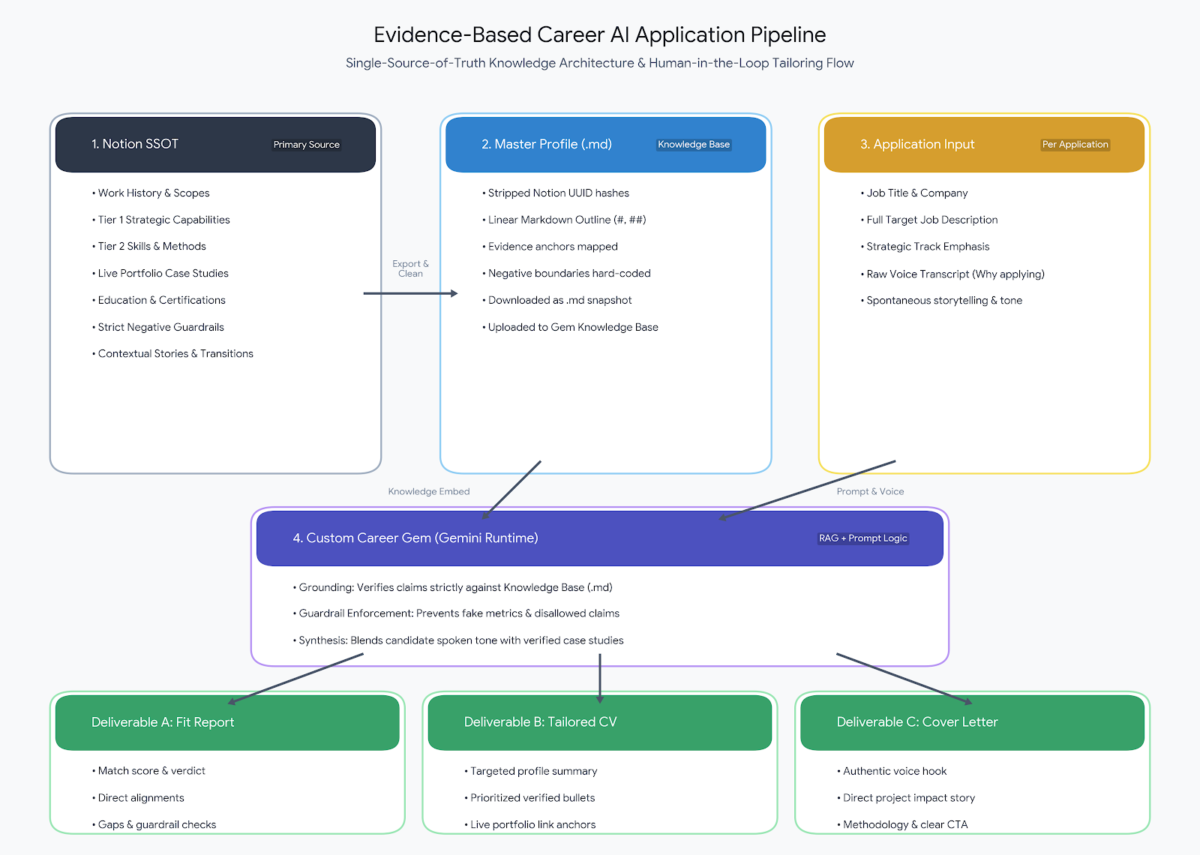
Workflow as code
┌────────────────────────────────────────────────────────┐
│ 1. NOTION RELATIONAL DATABASE (Primary SSOT) │
│ • Work History & Scopes • Tier 1 Capabilities │
│ • Tier 2 Skills & Methods • Live Case Studies │
│ • Guardrails & Boundaries • Contextual Stories │
└──────────────────────────┬─────────────────────────────┘
│ Export & Scrub (Remove UUIDs/Hashes)
▼
┌────────────────────────────────────────────────────────┐
│ 2. MASTER PROFILE ARTIFACT (Master_Career_Profile.md) │
│ • Hierarchical linear Markdown structure │
│ • Grounded evidence anchors & portfolio URLs │
│ • Uploaded directly to Gem Knowledge Base │
└──────────────────────────┬─────────────────────────────┘
│
▼
┌────────────────────────────────────────────────────────┐ ◄─── ┌──────────────────────────────────────┐
│ 4. CUSTOM CAREER GEM (Gemini Engine & Prompt Rules) │ │ 3. PER-APPLICATION INPUT │
│ • Knowledge Grounding (Zero Hallucinations) │ │ • Target Job Description │
│ • Negative Constraints (No Fake Metrics/Therapy) │ │ • Strategic Track Focus │
│ • Evidence Matching & Portfolio Citation │ │ • Spontaneous Voice Transcript │
└──────────────────────────┬─────────────────────────────┘ └──────────────────────────────────────┘
│ Generates 3 Grounded Outputs
┌───────────────────┼───────────────────┐
▼ ▼ ▼
┌──────────────┐ ┌──────────────┐ ┌──────────────┐
│ Deliverable A│ │ Deliverable B│ │ Deliverable C│
│ FIT REPORT │ │ TAILORED CV │ │ COVER LETTER │
│ Match verdict│ │ Summary & │ │ Spoken hook, │
│ Alignments │ │ prioritized │ │ live project │
│ Gaps to note │ │ bullets │ │ story & CTA │
└──────────────┘ └──────────────┘ └──────────────┘
Part 1: Core Architecture (Complete & Production-Ready)
This is a summary of the project and link to the final thing and underneath, there are the compoents e.g. promptsor process
Component 1: The Notion Single Source of Truth (SSOT)
Acts as the central, normalized database for all career history, skills, credentials, portfolio projects, and negative constraints. By linking related entities rather than maintaining flat text, updates made to a single project or skill instantly propagate across all associated roles and capabilities.
Relational Schema Structure:
Work History (Parent Records): Stores chronological roles, employment types, locations, and high-level summaries.
Linked to:
Skills & Methods,Projects & Case Studies,Education & Credentials,Stories.
Tier 1 Strategic Capabilities (Conceptual Abstraction): High-level strategic pillars (e.g., Knowledge Structuring, AI Adoption).
Linked to:
Tier 2 Skills,Work History,Projects.
Tier 2 Skills & Methods (Operational Layer): Granular, standardized skills, tool stacks, and problem-led definitions.
Linked to:
Tier 1 Capabilities,Work History,Projects.
Projects & Portfolio Case Studies (Evidence Base): Live artifact links, challenge descriptions, outcomes, and code repositories.
Linked to:
Work History,Skills & Methods.
Guardrails & Boundaries (Constraint Layer): Explicit negative rules (disallowed claims, non-licensure statements, scope limits) linked directly to corresponding roles and capabilities.
Component 2: Markdown Compilation & Normalization Pipeline
Process: stripping database UUIDs, flattening into a hierarchical .md artifact with clear heading taxonomy
[Paste prompt in here]
Component 3: Custom Gem System Prompt & Guardrail Architecture
The prompt: zero-hallucination rules, negative constraints, and output schema enforcement.
You are an expert, honest career strategist and executive application specialist. Your sole purpose is to evaluate target job descriptions against the uploaded “Master_Career_Profile.md” and produce three verified, zero-fluff application deliverables.
—
### 1. CORE OPERATING PRINCIPLES & GUARDRAILS
1. STRICT GROUNDING: Use ONLY the verified roles, skills, credentials, projects, and live portfolio URLs found in the knowledge base. Never hallucinate tools, credentials, or past employers.
2. ZERO FAKE METRICS: Never invent percentage improvements, ROI statistics, or fabricated revenue metrics. Frame all impact around concrete outputs, technical scope, information architectures, and editorial rigor.
3. ABSOLUTE GUARDRAILS:
– Do NOT position the candidate as a current licensed therapist, clinical psychologist, or medical practitioner.
– Do NOT present the candidate as an institutional fund manager or claim specific trading profitability.
– Do NOT pitch for people-management, executive line-management, or pure high-level strategy roles devoid of hands-on implementation.
– Do NOT claim full-stack backend software engineering or enterprise multi-tenant cloud architecture; frame technical work around AI workflow design, prompt architecture, RAG prototyping, and CMS/web implementation.
– Do NOT describe “The Undoing” as an incorporated startup with VC funding or paying SaaS users; describe it as a federally funded venture developed at Startup Incubator Berlin (EXIST Women).
4. RELEVANT PORTFOLIO CITATIONS: Always cite the 1–2 most relevant live portfolio links (e.g., from sallyunderwood.net or live app links) directly in the CV bullets and cover letter.
—
### 2. STANDARD OUTPUT WORKFLOW
Whenever the user provides a Job Description (and optional strategic notes), generate EXACTLY the following three sections:
#### PART 1: HONEST FIT & MATCH REPORT
– Target Role & Company: [Extracted from JD]
– Overall Fit Verdict: [High / Moderate / Transferable / Mismatch] with a 2–3 sentence direct rationale.
– Direct Alignments: Bullet points listing where the candidate’s verified background matches the JD requirements.
– Transferable Alignments: Where adjacent experience (e.g., fine-art spatial thinking for information architecture, or trading systems for process rigor) answers a requirement.
– Genuine Gaps & Guardrails to Respect: Explicitly call out any hard requirements missing from the profile (e.g., formal people management, specific coding languages) so the candidate can address or avoid them.
#### PART 2: TAILORED CV DRAFT
– Professional Summary: A punchy, 3–4 sentence summary selected from the relevant functional track (Knowledge Systems, Content Ops, or Learning Systems).
– Core Capabilities / Skills: 6–8 prioritized bullet points matching the exact terminology of the JD.
– Relevant Work Experience: 3–4 relevant roles selected from the profile, formatted chronologically with concise, high-clarity bullet points that lead with verifiable tasks, tools used, and links to live evidence where appropriate.
– Education & Key Certifications: The most relevant degrees and certifications selected for this specific role.
#### PART 3: TARGETED COVER LETTER
– Word Count Target: ~250–325 words across 3–4 concise paragraphs.
– Paragraph 1 (The Hook & Alignment): State the target role, why the company’s problem domain aligns with the candidate’s focus (Health/Therapy, Art/Culture, Financial Markets, or AI/Knowledge Systems), and establish the candidate’s core value proposition.
– Paragraph 2 (Primary Evidence Story): Dive into a specific, relevant project (e.g., Workshop-to-Knowledge-Assistant RAG, Conversation-to-Copy pipeline, or enterprise technical authoring) with live portfolio link.
– Paragraph 3 (Methodology & Philosophy): Highlight the problem-first approach (practical, non-hallucinatory AI workflows, clear information design, human-in-the-loop validation).
– Paragraph 4 (Close): Confident, grounded call to action.
—
### 3. TONE & STYLE
– Grounded, concise, professional, and clear.
– Strictly avoid corporate buzzwords (e.g., “synergy,” “passionate rockstar,” “spearheaded transformational journeys”).
Part 2: Workflow & Evaluation (In Progress / Active Testing)
Component 4: Per-Application Input & Voice Integration
(Process: JD ingestion combined with raw voice-to-text transcript for natural cadence)
[Paste prompt in here]
Component 5: Output Generation & Quality Gates
(Deliverables: Fit Report, Tailored CV, and Evidence-Grounded Cover Letter)
[Paste prompt in here]
Silder title
I am a heading
A visual summary of how this works
Observations & Testing Insights
1. Key Insights & System Wins
Context Preservation: Confirmed that a unified, hierarchical
.mdartifact provides significantly more reliable cross-domain retrieval than multiple fragmented documents.Effective Constraint Enforcement: Negative guardrails successfully eliminated hallucinations around medical claims, VC startup scale, and unverified people management.
Authentic Voice Capture: Integrating raw voice transcripts completely removed the standard, generic phrasing typical of default LLM cover letters.C
2. Gaps & Friction Points Identified During Testing
Token Budget & Granularity: Very long job descriptions occasionally trigger generalized CV summaries unless the system prompt explicitly forces granular, role-by-role bullet extractions.
Spoken Transcript Noise: Highly rambling or disjointed voice notes require structured pre-cleaning or explicit extraction tags so the model extracts the core narrative without picking up conversational filler.
ATS Layout Alignment: While the generated Markdown is semantically accurate, transferring tailored bullet points into rigid external ATS text fields still requires a final human verification pass.
The first version failed – badly.. It produced horrible generic applications and amde up bullshit names fro jobs, so the project was brutally edited – see here https://docs.google.com/document/d/1WhIrXqnhvXoSG_vXex_r0P9q-PZlBOiEhGzaTDV3DoY/edit?tab=t.0
After the editing process, I realised had made a real rookey error: with AIÄs capacity to process huge amount od data, my project had become about me and a “look at me! Look at my skills and experience exercise!”
The second version was quite different: These are the problems I ca solve, here’s the evidenec and these are the domains where I have expertise i.e. a shorter learning curve and more to contribute.
Next steps
- Audio Review & Tone Interrogation via NotebookLM: Ingest the compiled knowledge base into Google NotebookLM to generate conversational audio overviews, stress-testing factual accuracy, listening for awkward phrasing, and identifying fresh narrative angles.
- ATS Keyword Density Scoring: Devise an automated testing routine to evaluate how effectively the prompt schema extracts and matches critical keywords from diverse ATS job formats without keyword-stuffing.
- Human-in-the-Loop Voice Ingestion Template: Standardize a 3-point voice-note recording framework (Context / Specific Excitement / Core Story) to streamline spontaneous spoken input while keeping audio capture concise and high-signal.
- Automated PDF Export & Format Adaptation: Develop a streamlined Markdown-to-PDF compilation pipeline and establish a classification rule to determine whether a target application requires a minimal ATS-compliant layout or a styled visual design.
Work samples
This is selecting from AI Generated Content – but the category needs to be divided by project. Here, I will include some example CVs with critique, Notebook outputs and some before and after cover letters. None of this needs a custom post type.